A practical recovery guide for UAE residents
There is a moment many UAE residents know too well.
You open your banking app after a major payment clears — the rent cheque, annual school fees, car insurance renewal, or a medical expense — and the number staring back at you feels uncomfortable. Your emergency fund, once reassuring, now looks thinner than it should.
This isn’t poor money management. It’s the reality of living in the UAE.
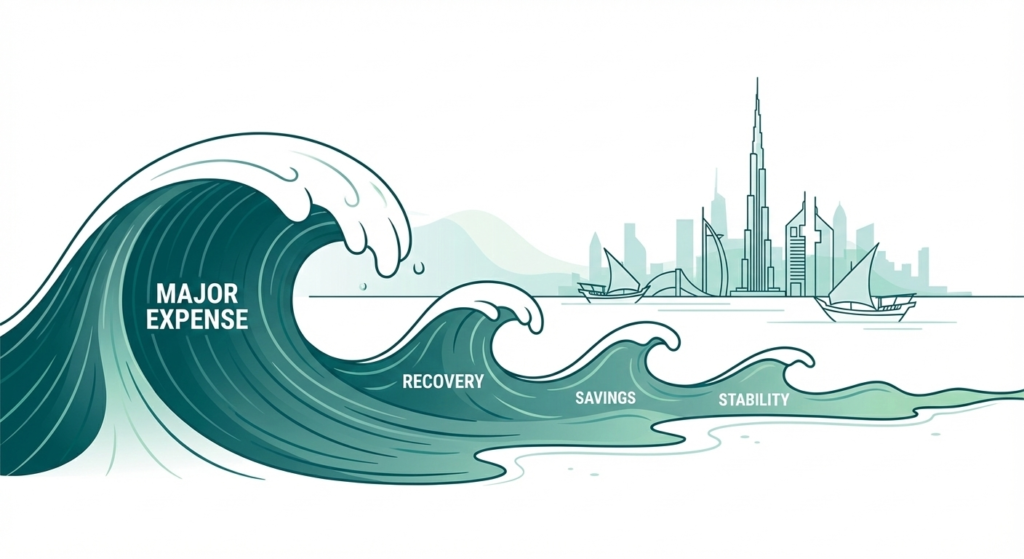
Here, expenses rarely arrive gently. They arrive in large, predictable waves. Rent is paid in cheques. School fees are due upfront. Insurance, registration, and relocation costs often hit together. Even well-planned budgets can feel stretched after one big outflow.
At Finfigs, we call this the UAE Expense Hangover — that temporary financial shock after a legitimate, unavoidable cost.
The good news? A depleted emergency fund does not mean financial instability — unless it stays depleted.
This guide is designed to help you rebuild your emergency fund methodically, without panic, shortcuts, or unrealistic advice. It’s not about extreme frugality. It’s about regaining control — in a way that works specifically for the UAE lifestyle.
What ?
Not looking to rebuild your emergency fund. Instead you want to know about the the emergency fund first. Read our article The 180-Day Shield: Building a Fail-Safe UAE Emergency Fund in 2026.
Also read the blog The 2026 Guide to Emergency Fund in the UAE: Financial Literacy That Protects Your Visa, Income & Peace of Mind for significance of emergency fund and some tips on savings.
Understanding the Reality of Saving in the UAE
The UAE is a convenience-first economy.
Food, transport, groceries, and services are engineered for speed. With a few taps, almost anything can be delivered to your door — often at a premium you don’t consciously register.
This makes saving money in Dubai and Abu Dhabi different from many other countries. The challenge isn’t income. For most professionals, income is stable. The challenge is frictionless spending.
When a major expense drains your emergency fund, the objective isn’t simply “spend less.”
The objective is to rebuild liquidity quickly so that the next expense does not push you toward debt.
Why to rebuild Emergency Fund — Not Just a Top-Up
In the UAE, an emergency fund isn’t only for emergencies in the traditional sense.
It functions as a financial shock absorber, protecting you from:
- Sudden car repairs (especially post-summer)
- Emergency flights to your home country
- Security deposits and moving costs
- Temporary job transitions or delayed payments
- Unexpected medical or family obligations
When this buffer is low, even normal expenses feel stressful. That stress leads to poor decisions — credit card reliance, delayed payments, or dipping into long-term investments.
Rebuilding your emergency fund is not optional. It’s foundational.
Phase 1: The 7-Day Financial Stabilisation Phase
Before rebuilding begins, you need to stop financial leakage. The first seven days after a major expense should focus on awareness and control.
1. Identify Hidden Cash Leaks
Subscription creep is extremely common in the UAE.
Open your banking app and review the last 30 days of transactions carefully.
Common culprits include:
- Multiple food delivery memberships (Talabat Pro, Careem Plus, Noon One)
- Gym memberships you rarely use
- Streaming platforms overlapping in content
- Premium apps or services set on auto-renew
Action:
Keep one delivery subscription if genuinely needed. Cancel everything else immediately.
This step alone often frees up AED 300–600 per month.
2. Temporarily Redefine “Needs” vs “Wants”
For the next 30 days, your definition of a “need” must become stricter.
Needs:
- Rent
- DEWA / utilities
- Basic groceries
- Fuel or transport
- Insurance and essential bills
Wants:
- Brunches
- Mall shopping
- Cafés and lounges
- Online impulse purchases
This isn’t permanent deprivation. It’s a short-term recovery rule.
Phase 2: Eliminating the UAE Convenience Tax
One of the fastest ways to rebuild savings in the UAE is to remove what Finfigs calls the Convenience Tax — the invisible premium you pay for speed.
1. The 30-Day App Reset
Food delivery apps are the most consistent drain on monthly cash flow.
Between:
- Marked-up menu prices
- Service fees
- Delivery fees
- Small order charges
You can easily overpay AED 35–50 per meal.
Strategy:
Delete food delivery apps for 30 days.
Pick up food yourself or cook at home. Most people discover an extra AED 1,500–2,000 in savings within a month.
2. Grocery Geography Matters
Where you shop matters as much as what you buy.
Premium supermarkets encourage premium baskets.
Recovery phase switch:
- From high-end stores → Viva, Union Coop, Lulu, Carrefour Market
- Buy private labels and staples in bulk
- Focus on produce and basics, not convenience foods
Quality remains acceptable. Costs drop meaningfully.
3. Reduce Utility Volatility
Utilities fluctuate significantly in the UAE, especially electricity and cooling.
Small adjustments can produce noticeable savings:
- Set AC to 24°C when home, 26°C when away
- Turn off water heaters during the day
- Avoid running appliances during peak hours
These changes can reduce bills by AED 200–400 monthly, which should go directly back into savings.
Phase 3: The 90-Day Emergency Fund Recovery Plan
Rebuilding works best when approached as a short sprint, not an endless struggle.
Month 1: Controlled Spending Mode
This is not about perfection — it’s about consistency.
- Cap lifestyle spending aggressively
- Replace paid entertainment with free alternatives:
- Beaches (Kite Beach, Mamzar)
- Parks (Zabeel, Mushrif)
- Walking tracks and cycling paths
- Beaches (Kite Beach, Mamzar)
- Combine errands to reduce fuel usage
The goal is to create surplus, not track every dirham obsessively.

Month 2: Activate Dormant Cash
Most UAE households have unused items with real resale value.
Examples:
- Electronics
- Furniture
- Kitchen appliances
- Branded clothing or shoes
- Fitness equipment
Action:
Sell 3–5 items via Dubizzle or local Facebook groups.
Target: AED 1,000–2,000
This is not income. It’s liquidity recovery.
Month 3: Automate the Rebuild
This is the most critical step.
Rule:
The day after your salary hits, transfer a fixed recovery amount — ideally 15–25% — into a separate savings account.
Why this works:
- You remove decision-making
- You eliminate “end-of-month leftovers” thinking
- You rebuild momentum automatically
If you wait to save what’s left, there will always be nothing left.
Phase 4: Preventing Future Emergency Fund Depletion
Once stability returns, prevention becomes the focus.
1. Neutralising Rent Shock
If you pay rent in multiple cheques, each payment acts like a financial cliff.
Solution:
Divide your annual rent by 12 and save that amount monthly.
When the cheque clears, the money is already reserved — and your emergency fund remains intact.
2. Predictable Costs Should Never Be Emergencies
School fees, car registration, insurance renewals — these are known in advance.
Treat them as monthly obligations, not annual surprises.
A simple spreadsheet or calendar reminder is enough to eliminate shock spending.
Behavioural Shifts: The Real Challenge in Dubai
The hardest part of rebuilding savings in the UAE is not budgeting — it’s social pressure.
Dubai normalises premium lifestyles. That doesn’t mean you need to participate at every level.
Avoid the Mall Spending Loop
In many countries, people walk in parks. In the UAE, they walk in malls — designed for spending.
Alternative:
Boardwalks, beaches, nature reserves, cycling tracks.
Reducing exposure reduces temptation.
Re-evaluate Transportation Costs
Cars in the UAE are expensive beyond purchase price:
- Fuel
- Salik
- Insurance
- Maintenance
- Depreciation
If rebuilding savings feels impossible, reassess:
- Do you need two cars?
- Can public transport cover part of your commute?
Transportation adjustments can free significant monthly cash flow.
A Note on Credit Cards During Recovery
Credit cards are useful tools — but dangerous when emergency funds are low.
Using credit to fund daily expenses without a clear 30-day payoff plan turns a temporary issue into long-term debt.
Recovery rule:
If you cannot afford it in cash during your 90-day reset, you don’t buy it.
Your Emergency Fund Recovery Checklist
Week 1
- Cancel unused subscriptions
- Delete food delivery apps
Month 1
- Switch to budget supermarkets
- Reduce lifestyle spending sharply
Month 2
- Sell unused items to inject cash
Month 3
- Automate savings immediately after salary credit
Ongoing
- Divide annual expenses by 12 and save monthly
Final Thoughts: Stability Is the Real Luxury
Rebuilding your emergency fund after a major UAE expense isn’t about restriction. It’s about restoring control.
In a fast-paced environment like Dubai or Abu Dhabi, financial flexibility is one of the most valuable assets you can have. When your emergency fund is strong, expenses don’t create anxiety — they become manageable events.
The UAE offers immense opportunity. But opportunity is best pursued from a position of stability.
Start your 90-day reset today — and let your emergency fund work for you, not against you.