The UAE grocery landscape in 2026 is a paradox. While official food inflation is projected to stabilize around 2.7%, anyone walking down a supermarket aisle in Dubai or Abu Dhabi knows the “receipt reality” feels much heavier. Between the subtle “shrinkflation” of your favorite biscuits and the 15% convenience markup on delivery apps, your monthly budget is under constant siege.
At finfigs, we believe financial literacy isn’t just about stocks and bonds—it’s about mastering the “invisible leaks” in your daily life. This guide – Save Money on Groceries isn’t about eating less; it’s about shopping smarter using 2026 data and “street-smart” UAE community strategies.
The 2026 “Grocery Leak” Check
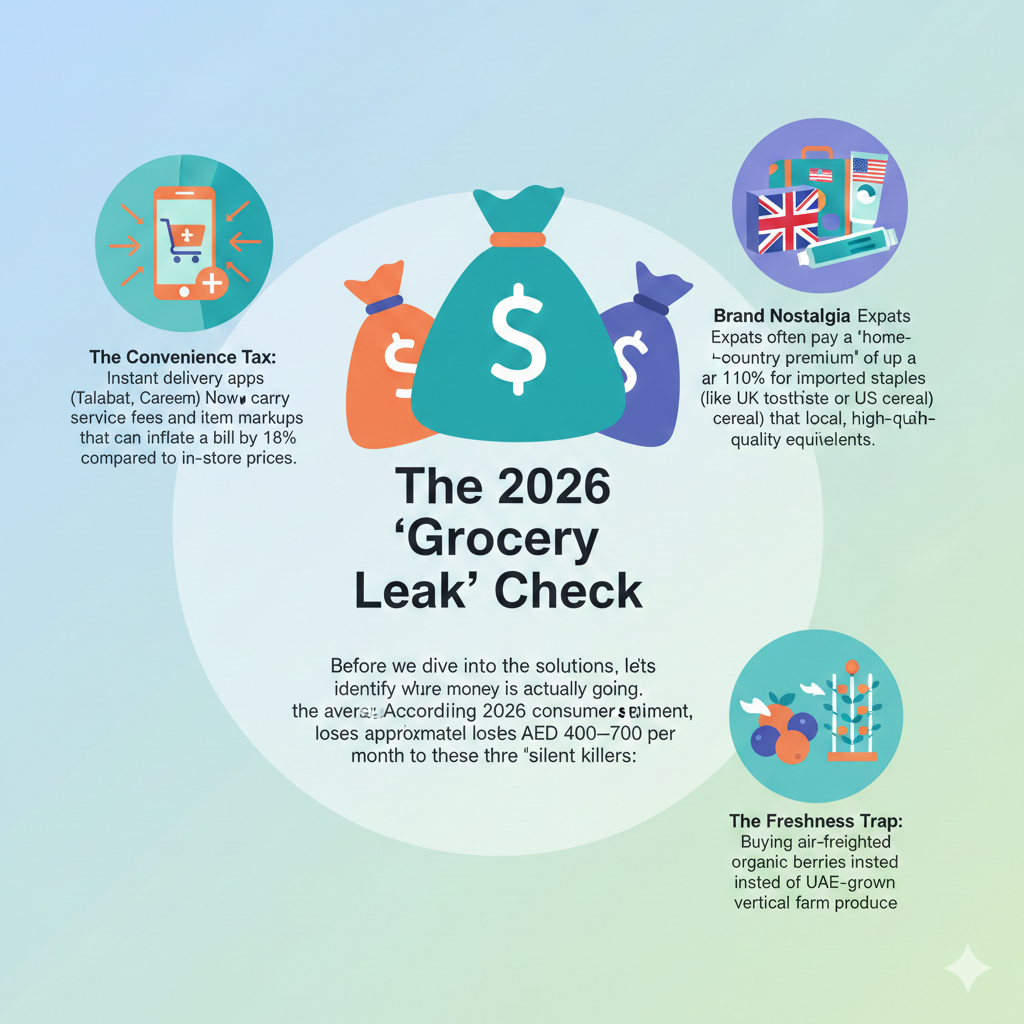
Before we dive into the solutions, let’s identify where your money is actually going. According to 2026 consumer sentiment, the average UAE resident loses approximately AED 400–700 per month to these three “silent killers”:
- The Convenience Tax: Instant delivery apps (Talabat, Careem, Noon) now carry service fees and item markups that can inflate a bill by 18% compared to in-store prices.
- Brand Nostalgia: Expats often pay a “home-country premium” of up to 110% for imported staples (like UK toothpaste or US cereal) that have local, high-quality equivalents.
- The Freshness Trap: Buying air-freighted organic berries instead of UAE-grown vertical farm produce.
1. The “Brand Loyalty” Swap: The 80/20 Rule
In 2026, private-label (store-brand) adoption in the UAE has surged by 25%. Brands like Carrefour Selection, Lulu Celebrate, and Viva have bridged the quality gap.
- The Strategy: Apply the 80/20 Swap.
- The 80%: Switch your “commodity” items—flour, sugar, salt, cleaning supplies, and UHT milk—to store brands. You will save roughly 40% on these items with zero impact on your lifestyle.
- The 20%: Keep your “Identity Brands.” If you can’t live without a specific brand of coffee or chocolate, keep it. Financial wellness is about sustainability, not deprivation.
2. The “Community Co-op” Strategy: Bulk Buying with Neighbors
In 2026, the concept of the “Wholesale Warehouse” has moved from the industrial zones of Al Quoz and Ajman directly into UAE residential buildings. With the rise of building-specific WhatsApp and Telegram groups, residents are bypassing retail markups by pooling their purchasing power.
- The Problem: Buying in bulk (e.g., a 20kg bag of Basmati rice or a 24-pack of oat milk) offers the lowest unit price, but for a family of three or a solo founder, it’s too much volume. It leads to cluttered pantries or food expiring before it’s used.
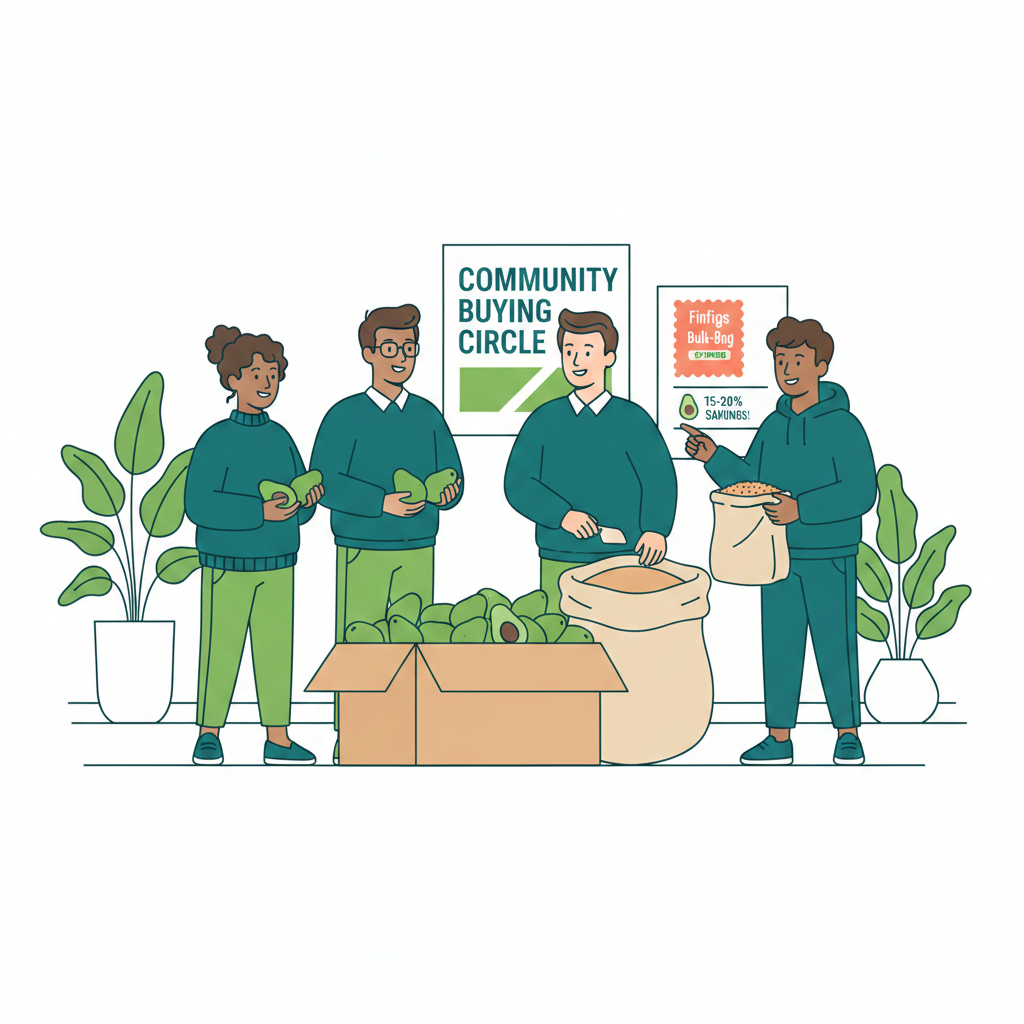
- The Solution: Micro-Cooperative Buying. Organize or join a “Buying Circle” within your community. By splitting a wholesale crate of avocados or a bulk sack of grains, you access the “Bismi Wholesale” or “Baqer Mohebi” price points without needing a commercial-sized pantry.
- Context: Community sentiment in 2026 shows a 35% increase in organized “Bulk Splits” within gated communities and apartment clusters. It’s no longer just about the money; it’s a way for neighbors to connect and fight the rising cost of living together.
- Pro Tip: The “Staple Swap” Meeting. Once a month, dedicate a “Swap Saturday” in your building’s common area. One neighbor buys the bulk detergent, another the bulk olive oil, and you divide them on-site.
- Finfigs Wisdom: Ask yourself: Does my building have a community group? If not, starting a “Finfigs Bulk-Buy” thread could save everyone in your circle 15-20% on monthly essentials.
3. Defeating “Shrinkflation” with Unit Pricing
Manufacturers in 2026 have mastered the art of “less for the same.” A standard bag of chips that was 170g in 2024 is now likely 155g in 2026, while the price remains AED 7.50.
- The Solution: Look at the Unit Price (Price per kg/100g) on the shelf tag. Most major retailers like Union Coop and Carrefour now display this in small print.
- Pro Tip: Often, the “Family Pack” is actually more expensive per kg than two smaller packs during a promotion. Always let the math, not the packaging, guide you.
4. The “Emirati-Fresh” Priority: Local Over Organic
The UAE’s investment in GigaFarms and vertical farming has reached a tipping point in 2026. Local produce is no longer just “cucumbers and tomatoes.”
- The Data: Local vertical-farm leafy greens (kale, spinach, arugula) are now 30-50% cheaper than imported organic equivalents and have a 3x longer shelf life because they weren’t flown across an ocean.
- The Move: Look for the “Product of UAE” logo. In 2026, “Local” is the new “Premium.” It’s fresher, cheaper, and more sustainable.
5. The “Anti-Instant” Protocol (For Solo Founders & Busy Professionals)
If you are a solo founder or a full-time employee, time is money. But “Quick Commerce” (15-minute delivery) is a budget-buster.
- The Strategy: Benchmark the “Bulk & Top-up” model.
- The Monthly Run: Use a warehouse-style store (like Nesto or Baqer Mohebi) for non-perishables.
- The Digital Filter: Use apps for scheduled delivery only (next-day). These usually have lower markups and often offer “Free Delivery” for orders over AED 100.
- The Finfigs Question: Have you audited your app history lately? Check your “Service Fees” and “Small Basket Fees” for the last 30 days—you might be surprised to find a hidden AED 300 “laziness tax.”
6. The “Modular Meal” System: Stop the Rot
Food waste is the ultimate financial sin. In the UAE, where we often buy in bulk but eat out spontaneously, waste is high.
- The System: Instead of prepping full meals, prep Components.
- Roast a tray of Mediterranean veggies, boil a pot of quinoa, and grill three chicken breasts.
- Monday: Quinoa bowl. Tuesday: Chicken wrap. Wednesday: Veggie pasta.
- This “Modular” approach takes 45 minutes on a Sunday and prevents the “I don’t feel like eating that specific meal” excuse that leads to ordering delivery.
Where to Shop in 2026? A Quick Comparison
| Supermarket | Best For… | Budget Rating |
| Viva | European-style discounter, incredible for staples. | ⭐⭐⭐⭐⭐ |
| Lulu / Nesto | Bulk buying, fresh spices, and Indian/Asian brands. | ⭐⭐⭐⭐ |
| Union Coop | Fresh local produce and high-quality meats. | ⭐⭐⭐⭐ |
| Carrefour | “One-stop-shop” with excellent private labels. | ⭐⭐⭐ |
| Spinneys / Waitrose | Specialty items and “treat-yourself” moments. | ⭐⭐ |
Your 2026 Action Plan
Saving money on groceries in the UAE isn’t about clipping coupons; it’s about a mindset shift from “Consumer” to “Strategist.”
- Identify your 5 most expensive recurring items and see if a local or store-brand version exists.
- Delete “Instant” delivery apps for one week and see how it affects your spending.
- Check the price-per-unit on your next shop.