Living in the UAE comes with undeniable advantages—tax-free income, modern infrastructure, safety, and access to global opportunities. For many residents, Dubai or Abu Dhabi is not just a workplace but a carefully built life.
However, there is an unspoken rule that every expat eventually learns: financial stability in the UAE is directly tied to residency stability.
As we move through 2026, the economic environment has matured. The post-pandemic rent surge has eased thanks to new housing supply, yet the overall cost of living remains structurally high. More importantly, employment-linked visas, education commitments, and fixed annual payments mean that a single income disruption can quickly escalate into a residency decision.
In the UAE, an emergency fund is not merely a “rainy day” buffer.
It is a residency protection tool—and in some cases, a repatriation safety net.
This Finfigs checklist breaks down a UAE-specific emergency fund into two practical layers:
- The Survival Tier – staying solvent and legal while you regroup
- The Repatriation Tier – the true cost of exiting the UAE on your own terms
1. The Survival Tier: Your 6-Month Liquidity Buffer
In many countries, an emergency fund covers rent, groceries, and utilities.
In the UAE, it also covers time.
If your primary income stops, the grace period clock begins—whether due to job loss, business closure, or contract non-renewal. Your emergency fund must sustain your household long enough to secure a new role, switch visa status, or restructure your plans without panic.
Step One: Calculate Your Monthly Burn Rate
Your “burn rate” is the minimum amount required to maintain legal residency and daily life without lifestyle inflation.
Below is a 2026 UAE-specific baseline, designed to reflect realistic—not optimistic—costs.
Essential Monthly Expense Checklist (2026)
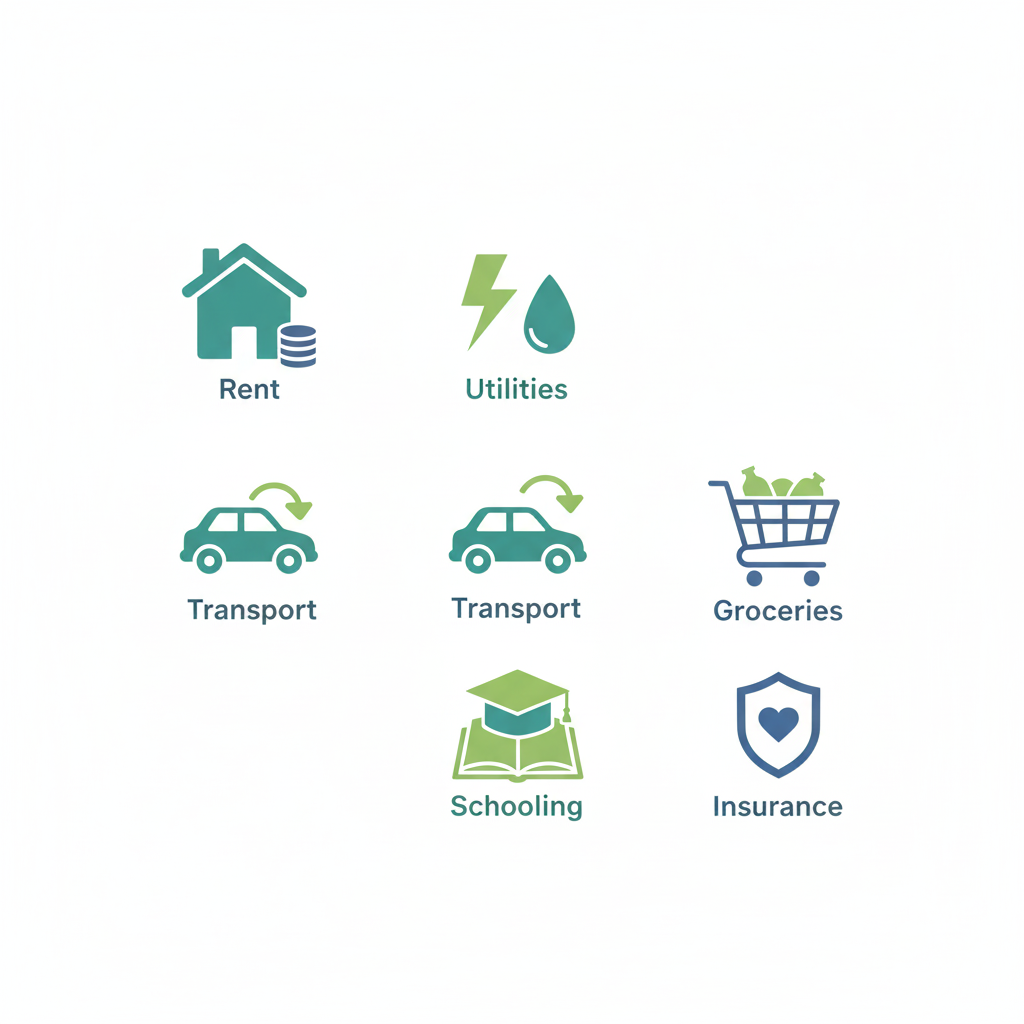
| Expense Category | Family of 4 (AED) | Single (AED) | 2026 Considerations |
| Housing (Rent / Ejari) | 12,000 – 18,000 | 5,500 – 8,500 | Include 5% municipality fee via DEWA |
| Utilities (DEWA / ADDC) | 1,200 – 1,800 | 400 – 700 | Water, electricity, sewerage |
| Cooling (Chiller) | 800 – 1,500 | 300 – 500 | Often billed separately |
| Internet & Mobile | 800 | 400 | Home fibre + mobile plans |
| Groceries & Supplies | 3,500 – 5,000 | 1,200 – 1,800 | Reflects moderate food inflation |
| Transport & Fuel | 1,500 | 600 | Salik, insurance, maintenance |
| School Fees (Pro-rated) | 4,000 – 7,000 | N/A | Based on 10-month instalments |
| Mandatory Insurance | 100 | 50 | ILOE + basic health co-pays |
| Estimated Monthly Burn | 24,000 – 41,200 | 8,450 – 12,550 | Use your actual numbers |
Finfigs Note:
The above is an example of the expenses. Use your own calculations for the above types of expenses. Always calculate using your highest likely monthly cost, not your average. Emergencies rarely happen in “cheap months.”
2. The Repatriation Tier: The Cost Most People Ignore
The biggest emergency-fund mistake in the UAE is assuming you will always be able to stay.
A proper UAE emergency fund must include exit optionality—the ability to leave without debt, distress, or rushed decisions.
Even when employers cover airfare, the real cost of leaving the UAE is far higher.
The UAE Repatriation Cost Checklist
1. Lease Cancellation Penalty
Most tenancy contracts require two months’ rent for early termination.
- Annual rent: AED 120,000
- Penalty: ~AED 20,000
- Payable immediately to release Ejari
2. Shipping & Relocation
In 2026, international relocation costs remain elevated.
- 20-ft container (Europe / Indian Subcontinent):
AED 15,000 – 25,000 - Includes packing, customs handling, and insurance
3. Utility Clearances
DEWA and ADDC require final settlement before issuing move-out certificates.
- Deposits are refundable
- Final summer bills often absorb most or all of the refund
4. Visa Status Changes
If you need time to sell assets or remain legally present:
- Job Seeker / Green Visa (5-year):
AED 2,300 – 3,500 per person (2026)
5. Emergency Airfare
Last-minute, one-way tickets during peak travel periods can be expensive.
- Family of four: AED 8,000 – 12,000
- Higher during school holidays and year-end
Reality Check:
Leaving the UAE without preparation often forces residents into personal loans or credit card rollovers—exactly what an emergency fund is meant to prevent.

3. The 2026 UAE Emergency Fund Formula
Finfigs uses a two-part calculation to arrive at a realistic emergency fund target.
The Formula
Total Emergency Fund = (Monthly Burn × Buffer Months) + Repatriation Costs
Example 1: Family of Four (Dubai)
- Monthly burn: AED 30,000
- Buffer: 6 months = AED 180,000
- Repatriation costs: AED 45,000
Target Emergency Fund: AED 225,000
Example 2: Single Professional (Abu Dhabi)
- Monthly burn: AED 10,000
- Buffer: 6 months = AED 60,000
- Repatriation costs: AED 15,000
Target Emergency Fund: AED 75,000
Special Case: Freelancers & Golden Visa Holders
If your income is variable or self-generated:
- Extend buffer to 9 months
- No immediate access to End-of-Service Gratuity
- Income gaps tend to last longer than expected
4. Where to Keep Your UAE Emergency Fund
Liquidity is the primary rule—but in the UAE, access risk also matters.
While banking regulations have improved significantly by 2026, account restrictions can still occur during visa transitions or final salary processing.
What to Avoid
- Locking the full fund into fixed deposits
- Products with 30–90 day withdrawal notice
- Investment-linked savings plans
Practical Options
- High-liquidity digital savings accounts
- Instant or same-day transfers
- No penalties for withdrawals
The Finfigs “Split Strategy”
- 2 months of expenses in a secondary UAE account
- 4 months in an offshore or home-country account
This ensures:
- Access to funds even during local account reviews
- Immediate availability of “flight money” if required
5. Critical UAE-Specific Risks to Watch in 2026
The School Fee Trap
Many UAE schools withhold Transfer Certificates (TCs) if fees are unpaid.
- Without a TC, children cannot enroll elsewhere
- Always protect at least one full term of school fees within your emergency fund
The ILOE Misconception
The Involuntary Loss of Employment scheme provides:
- 60% of basic salary
- Up to 3 months
However:
- Claims may take time to process
- Coverage is capped
- It should preserve your fund—not replace it
Rent Adjustment Costs
Even with rental moderation in 2026:
- Downsizing still requires upfront cash
- Factor in:
- 5% security deposit
- 5% agency fee
- Utility deposits
- 5% security deposit
RERA calculators help with rent caps—but moving itself is never free.
Conclusion: Your UAE Emergency Fund Is Your Freedom Fund
In the UAE, an emergency fund is not about pessimism.
It is about control.
Control over your timeline.
Control over your residency.
Control over your family’s stability.
It allows you to walk away from unhealthy work environments, withstand economic slowdowns, and make decisions from a position of strength—not urgency.
Your 24-Hour Finfigs Action Checklist
- Calculate your real burn rate using Section 1
- Check your gratuity balance as a secondary buffer
- Open a shadow savings account with a separate bank
- Fund your first AED 20,000 immediately
From there, consistency—not speed—does the rest.
At Finfigs, we don’t believe financial security comes from complexity.
It comes from clarity, preparation, and realistic planning—built for the UAE, not borrowed from elsewhere.