The UAE in 2026 remains a global beacon of safety, infrastructure, and career opportunity. However, the economic landscape has shifted from a “simple tax haven” to a “sophisticated global financial hub.” This transition has introduced a phenomenon known as “Cost Creep”—the gradual rise of baseline living expenses driven by new regulatory frameworks, environmental levies, and a maturing real estate market leading to high UAE cost of living.
For the residents of 2026, the challenge is no longer about high-income tax; it is about managing the dozens of small, quiet fees and price adjustments that erode a monthly budget. In this guide, we break down these shifts and offer high-level solutions that can save a typical family over AED 85,000 per year.
Total Annual Savings Opportunity Highlighted in this Article:
By implementing the “Street-Smart” frameworks below, a household of four can achieve the following cumulative savings:
- Housing & Mobility Arbitrage: ~AED 45,000
- Healthcare Prevention Shield: ~AED 12,500
- Zero-Waste Grocery Wealth: ~AED 9,600
- Education Fee Optimization: ~AED 15,000
- Digital Security Resilience: ~AED 3,000 (Loss Prevention)
- Total Savings: AED 85,100
2026 Reality: Why the “Floor” of Living Costs is Rising
In 2026, the core issue isn’t just standard inflation; it is the structural elevation of the survival floor. A few years ago, “living normally” had a predictable price tag. Today, that floor has risen due to a combination of indirect fiscal measures and regulatory maturity. The introduction of a 9% Corporate Tax for businesses (which eventually filters down to consumer prices), the expansion of Salik toll gates to manage a population surge, and the 2026 “Sugar & Plastic” environmental taxes have created a cumulative effect.
We are seeing a transition where convenience is being taxed more heavily than the items themselves. The “floor” is rising because the UAE is now pricing in its world-class services—safety, technology, and logistics—into the everyday transaction. To thrive, residents must move from a “reactive” spending habit to a “systems-based” financial design.
1. The Total Cost of Occupancy (TCO) Strategy
Housing remains the largest expense, but the 2026 market is no longer a one-way street of rising rents. While Dubai is seeing a massive supply of roughly 60,000 to 120,000+ new units aimed at stabilizing the market, Abu Dhabi is facing a supply deficit. This creates a geographical arbitrage opportunity.
The Solution: Geographical Arbitrage
Instead of choosing a home based on prestige, calculate the Total Cost of Occupancy (TCO). This formula looks like this:
TCO = Rent + (Commute) + (Salik) + (Chiller/Utilities)
The Calculation (How we reached the AED 45,000 savings):
- Scenario A (Prime Area): Renting a 3-bedroom in a central Dubai district at AED 185,000/year. Commute is 10 mins (low fuel), but Chiller costs are high.
- Scenario B (Emerging Hub): Renting the same quality 3-bedroom in a community on the border of Dubai and Abu Dhabi at AED 130,000/year.
- Mobility Costs for Scenario B: AED 800/month fuel + AED 200/month Salik = AED 12,000/year.
- The Math: AED185,000 – (130,000 + 12,000) – approx. AED 2,000 Chiller savings = AED 45,000 (Annual Savings).
By widening your search to “inter-emirate hubs,” you are essentially trading 20 minutes of extra drive time for a “net raise” of nearly AED 4,000 per month.
2. The “Preventative Shield” Healthcare Model
Healthcare inflation in the Middle East is projected to reach 11.3% in 2026. As insurers face rising costs from chronic diseases like diabetes, they are passing these onto the consumer through higher co-pays and narrower hospital networks.
The Solution: Tiered Defense System
Instead of paying for the most expensive “Gold” insurance plan for every family member, adopt a concept used in high-efficiency global health systems: The Personal HSA (Health Savings Account).
The Calculation (How we reached the AED 12,500 savings):
- The Old Way: Upgrading a family of four to a “Premium Network” plan to avoid co-pays. Cost: AED 45,000/year.
- The New Way: Keeping the “Standard Network” plan (AED 30,000/year) and self-funding a “Health Buffer.”
- Personal HSA: Allocate AED 200/month per family member into a high-yield savings account (perfect for the future finfigs app). Cost: AED 9,600/year.
- Average Savings: $45,000 – (30,000 + 2,500 \text{ average actual co-pays paid}) = \mathbf{AED 12,500 \text{ Annual Savings}}$.
By treating routine medical visits as a “planned expense” rather than an “insurance event,” you stop paying a 30% premium for the possibility of a doctor visit.
3. Zero-Waste Wealth: Bypassing Environmental Levies
From January 1, 2026, the UAE has implemented a Tiered Sugar Tax (taxing drinks based on sugar content per 100ml) and a full ban on single-use plastics. Retailers are passing these costs directly to you.
The Solution: The Bulk-System Model
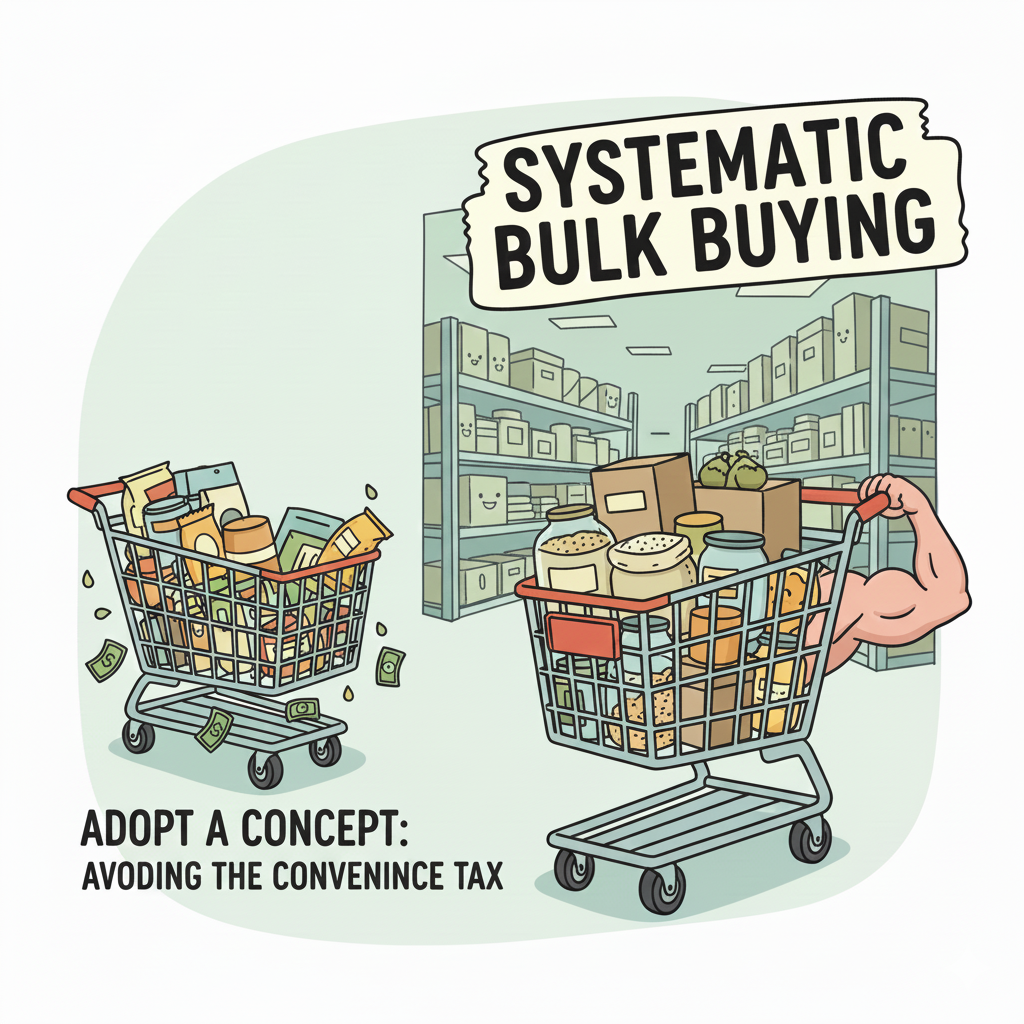
Adopt a concept used in highly regulated European markets: Systematic Bulk Buying. This isn’t just about “saving money”; it’s about “avoiding the convenience tax.”
The Calculation (How we reached the AED 9,600 savings):
- The Habit: Buying daily bottled water, individual snack packs for school, and paying for plastic-alternative bags at checkout. Estimated Cost: AED 1,000/month.
- The System: Installing a high-grade home water filtration system (AED 1,500 one-time), buying bulk grains/snacks, and using high-quality reusable containers.
- Operating Cost: AED 200/month for bulk refills.
- The Math: AED (1,000*12) – (200*12 + 1,500) = AED 8,100 Savings in Year 1, rising to AED 9,600 in subsequent years.
4. The Education Fee Optimization Strategy
With dozens of new schools opening in 2026, the market is shifting toward a “Buyer’s Market” in education. However, schools rarely advertise their best rates.
The Solution: The “Fact-Sheet” Audit
Every school in Dubai is now required by the KHDA to provide a “School Fees Fact Sheet.” This document is your most powerful negotiation tool.
The Calculation (How we reached the AED 15,000 savings):
- The Mistake: Paying the “Sticker Price” for a premium school at AED 75,000/child.
- The Smart Move: Identifying a “Very Good” rated school with a 20% lower fee structure (AED 60,000/child) that offers better “Corporate Discounts.”
- The Negotiation: Many schools offer unadvertised 10-15% discounts for families in certain Freezones or industries.
- The Math: AED (75,000 – 60,000) = AED 15,000 Savings per Child.
By focusing on the “Inspection Rating vs. Price” ratio rather than the “School Brand,” you can achieve identical academic outcomes while saving the equivalent of a luxury family vacation.
5. Digital Security Resilience
In 2026, the UAE is phasing out SMS-based OTPs (One-Time Passwords) in favor of app-based biometric authentication (like UAE Pass) to prevent fraud.
The Solution: The “Digital Fortress” Framework
Financial loss from “SIM-Swapping” or digital identity theft is a hidden cost that can reach thousands of dirhams. Resilience isn’t just about software; it’s about Hardware Separation.
The Calculation (How we reached the AED 3,000 Loss Prevention):
- The Risk: Carrying your primary banking and investment apps on the same phone you use in public Wi-Fi zones.
- The Solution: Use a dedicated “Home Phone” (an older, updated device) for all banking authentication.
- Savings: While hard to quantify as a “monthly saving,” the average cost of recovering from a digital identity breach in the UAE is estimated at AED 15,000 in time, legal fees, and lost funds. Preventing even one breach over 5 years equals AED 3,000/year in “Risk-Adjusted Savings.”
Conclusion: The New Definition of “Enough”
In 2026, the UAE rewards those who treat their personal finances with the same rigor as a corporate budget. The “Cost of Living” isn’t a fixed number; it is a variable you can control through strategic geography, preventative health planning, and digital resilience.
By implementing these frameworks, you aren’t just “cutting back”—you are optimizing. You are taking the AED 85,000 that would have disappeared into “cost creep” and moving it into investments, your children’s future, or your own business ventures.
The UAE remains the land of opportunity. In 2026, the greatest opportunity of all is Financial Literacy.